
Dr. Aruna Ashok MBBS, MS OG, DNB OG
- Clinical Director


 Aruna Ashok | 16 July 2023
There are numerous scenarios where the egg rupture is identified during follicular study, but women face challenges in conceiving. Egg rupture (ovulation) is obviously the big moment in your menstrual cycle to make conception possible. But why doesn’t it happen
Find out the potential causes of egg rupture but not conceived with effective solutions from A4 Fertility experts
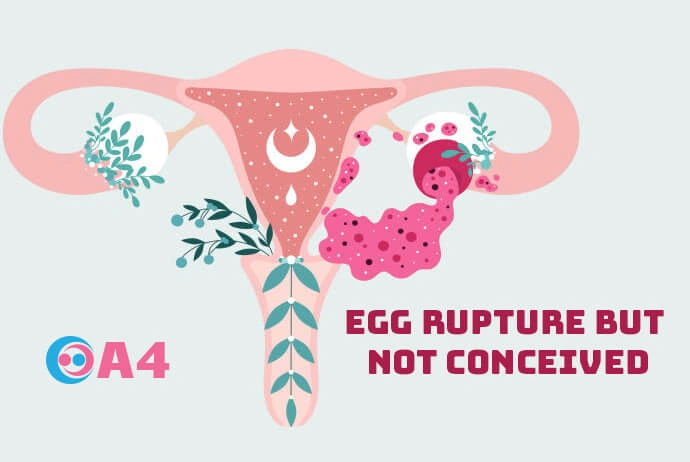
Egg rupture is, after all, a natural process that happens every month in the middle of the menstrual cycle. It is when a mature follicle in the ovary ruptures to release an egg with the hope of being fertilised by the sperm. It’s important to understand that only one follicle ruptures in a natural cycle, though multiple follicles begin to develop
The conception failure after egg rupture is primarily caused by
Studies claim that even young, healthy couples (under age 35) have only a 20 to 25 % chance of conceiving naturally in a cycle. This narrow probability is due to the shorter surviving span of the ruptured egg.
It’s important to know that fertilisation happens in the fallopian tubes. Once fertilised, the egg travels down to the uterus for potential implantation.
The ruptured egg can wait for the sperm in the fallopian tubes for only about 12 to 24 hours. If the timing is missed, the pregnancy may not happen in that particular cycle.
Sperm abnormalities – including poor motility (movement), abnormal morphology (shape) and low sperm count – can cause conception failure even with perfectly timed intercourse.
All of which are responsible for causing unsuccessful attempts at conception.
Poor egg quality can be another reason for conception failure, even if ovulation is successful. While the follicular study can provide information about the growth of follicles and the timing of ovulation, it cannot visualise the quality of the egg inside. As women age, the quality of their eggs often declines, increasing the likelihood of chromosomal abnormalities. This can result in failed fertilisation, poor embryo development, or implantation failure.
Conditions like PCOS and endometriosis can also decrease the quality of eggs.
When the essential pathway of fertilisation is blocked, sperm and egg cannot meet. This ultimately prevents natural conception, even if the egg is released (ovulation). Ovulation can still happen with the blocked tubes because it is a hormonal process that occurs in the ovaries, not in any way related to the tubes. The ruptured egg only uses the fallopian tubes to get fertilised with the sperm and pass through them to reach the uterus. When this crucial pathway is blocked, it can undoubtedly hinder conception. The partial blockage (blockage in one tube) can sometimes make fertilisation possible but increase the risk of an ectopic pregnancy as it inhibits the movement of the fertilised egg.
The blockage is often caused by scarring, infections like pelvic inflammatory diseases, previous surgeries, or endometriosis. These act as a silent cause of female infertility.
A poor uterine environment can also cause conception failure after egg rupture, for that matter, even if fertilisation happens. Key reasons may include:
Thin or non-receptive endometrial lining: The uterine lining must be thick and receptive for the fertilised egg to implant into the lining. If it's too thin, it cannot be implanted. This can result in conception failure.
Structural problems: The presence of fibroids, polyps or scars in the uterine cavity can make the fertilised egg struggle to find a suitable place to attach. This can also prevent pregnancy.
Chronic inflammation: Chronic inflammation can disrupt the delicate endometrial lining necessary for implantation, creating an unfavourable environment for the embryo to attach and develop.
Improper timing of the implantation window: The uterine lining becomes receptive by thickening the endometrium to 8-12 mm, which is optimal for implantation. This usually happens between 6 and 10 days after ovulation. This timing is commonly referred to as the “implantation window”. This timing must synchronise with the development of the embryo for successful implantation. When this timing is misaligned – meaning, if the embryo arrives at the uterus too early or too late, implantation cannot occur.
Hormones play a key role in the overall reproductive health of a woman. Any imbalances in them can not only impact ovulation, but also implantation. Common hormonal imbalances that hinder conception, even if ovulation has occurred normally, may include :
Low Progesterone or Short Luteal Phase: After ovulation, progesterone levels are important to thicken the uterine lining to support implantation. If its levels are too low or the days after ovulation are shorter than usual, typically less than 10 days, the lining may not be thickened enough. This can potentially prevent the fertilised egg from attaching.
High Prolactin: Higher levels of prolactin in women can suppress ovulation, but if it's high after the egg rupture, it can hinder the conception process. This can happen as it disrupts the hormones like FSH/LH and progesterone, which are necessary for conception. High prolactin is often caused by conditions like hypothyroidism, PCOS, pituitary tumours, chronic kidney/liver disease, and extreme stress.
Estrogen and Progesterone Imbalance: There should be a delicate balance between estrogen and progesterone after ovulation to create a suitable uterine environment for the embryo to implant. The imbalance in them during the luteal phase (the days after ovulation) can disrupt this process, thereby preventing implantation even if the eggs are healthy. Common conditions associated with imbalanced estrogen and progesterone ratios may include fibroids, polyps, endometriosis, endometrial hyperplasia, and PCOS.
Androgen Excess: Conditions like Polycystic Ovary Syndrome (PCOS) can cause excessive production of androgen. While they can compromise the quality of eggs, it can also potentially interfere with fertilisation and disrupt the uterine environment that prevents the embryo from implantation.
Every month during egg rupture, the moment holds the abundance of hope to become pregnant. We understand how disheartening it can be when you notice negative results on the pregnancy test every time.
Here are some of the tips from A4 fertility experts that can greatly help with your journey towards a successful pregnancy:
Time Intercourse : If you are actively trying to become pregnant, identify your fertile window through symptoms like abdominal cramping, increased vaginal discharge, and light spotting. Then, plan to have unprotected intercourse around those days.
For example, if your cycle is 28 days, your ovulation is likely to happen on the 14th day. And your fertile window would be from the 9th to the 15th. If you have unprotected intercourse on those days, particularly on the 14th and 15th, your chances of becoming pregnant are much higher.
While the fertilisation typically happens around the time of ovulation, the conception (the implantation of the embryo into the uterine lining) takes about 5-10 days. In the meantime, it is important to focus on your overall health to support this process.
Manage Stress : Stress can be a major contributor to hindering conception by disrupting the hormonal balance. You can try to calm down through techniques like meditation, yoga, and walking.
Healthy Nutrition : Prefer consuming a balanced diet, including high-protein and enough nutrients that support your reproductive health.
Avoid Harmful Substances : Avoid harmful substances like smoking, alcohol, and vaping.
Prenatal Vitamins : Make sure you take folic acid every day to encourage conception. However, it is important to seek medical advice from a specialist.
If conception still doesn’t happen after trying for 6 to 12 months with the aforementioned methods, consult a specialist to analyse the underlying cause.
After the consultation, a doctor may recommend certain diagnostic procedures, which may include:
Semen Analysis : To evaluate the quality and quantity (count) of your partner’s sperm. Studies show that about 40-50% of infertility problems are related to male factors. That’s why many healthcare providers evaluate both partners.
Hysterosalpingography (HSG) : An HSG is a specialised X-ray, commonly used to check the patency (openness) of the fallopian tubes and the shape of the uterus.
Hormonal Profiles : In females, tests like AMH (Anti-Müllerian Hormone), FSH (Follicle-Stimulating Hormone), and LH (Luteinizing Hormone) are recommended to check ovarian reserve (the quantity of the remaining eggs) and their quality indirectly.
In males, tests like Testosterone, FSH and LH are recommended to evaluate sperm production. These are usually suggested when the results of semen analysis show abnormalities.
Based on the analysis and many unsuccessful natural attempts to achieve conception, the treatment options are recommended.
Ovarian Stimulation : Ovarian stimulation prompts the ovaries to produce multiple mature follicles instead of one, as in a natural cycle. This maximises the chances of a successful pregnancy, making multiple follicles available for fertilisation. It is commonly recommended for couples with unidentified infertility or aged couples (over 35). Ovarian stimulation is often combined with intrauterine insemination (IUI) or in vitro fertilisation (IVF).
Intrauterine Insemination (IUI) : IUI helps couples who are not conceiving but have a potential egg rupture by directly placing the concentrated high-quality sperm into the uterus at the precise moment of egg rupture. This method is effective for problems, such as mild male factor infertility and issues with cervical mucus.
In Vitro Fertilisation (IVF) : IVF is a standard fertility treatment when initial methods fail to help couples achieve conception, even when ovulation is occurring normally. The procedure involves stimulating multiple follicular growth, retrieving them directly from the ovaries, fertilising the retrieved egg with the partner’s sperm in a laboratory, and selecting the high-quality embryo for transfer.
IVF is widely recommended for couples with infertility due to blocked or damaged fallopian tubes, low sperm count, PCOS, uterine fibroids, endometriosis, or unexplained infertility.
ICSI (Intracytoplasmic Sperm Injection) : ICSI is a highly effective procedure where the sperm is directly injected into the egg to ensure 50-80% of fertilisation in a laboratory. This bypasses the need for natural fertilisation as in an IVF cycle. ICSI is often a part of the IVF procedure, especially when the male partner has severe sperm factors.
Alternative Options : In cases of multiple IVF failures, donor eggs or sperm are often considered to conceive a baby.
Egg rupture is a big moment in a menstrual cycle for pregnancy, though other biological sequences are crucial. After egg rupture, successful conception requires timed intercourse, high-quality sperm, healthy fallopian tubes, and an appropriate uterine lining for potential implantation. Other factors like hormonal balance, age, and healthy lifestyle habits also play a key role
Any worries regarding conception even after regular egg rupture should be discussed with the provider. They may find you the treatment option personalised to your specific circumstances.
1. Can I become pregnant if I don’t ovulate this month?
The answer to the question is no. You cannot become pregnant in a cycle where you don’t ovulate
2. Can pregnancy stop ovulation?
The answer to the question is yes. Pregnancy can typically stop your ovulation and menstruation until childbirth
3. What are the chances of pregnancy after egg rupture?
The chances of pregnancy after egg rupture are much higher. Though you are most fertile in the five days leading up to ovulation, on the day of ovulation, and the day after ovulation. Having sexual intercourse within 12 to 24 hours of egg rupture provides the highest probability of conception
4. Does an irregular period affect egg rupture?
The answer to the question is yes. Irregular periods can largely affect egg maturation and rupture, causing delayed, unpredictable, or absent ovulation
5. After egg rupture, how many days to get pregnant?
If fertilisation has happened after egg rupture, you are likely to get pregnant within 12 to 24 hours. Though the implantation, which is the establishment of the pregnancy, can happen between 5-10 days after fertilisation
6. When to take a pregnancy test after egg rupture
The best time to take a pregnancy test after egg rupture is on the day of your expected period or 12 to 14 days after the egg rupture


